
Venglustat for Gaucher disease
 Fact-checked by
 What is venglustat for Gaucher disease?
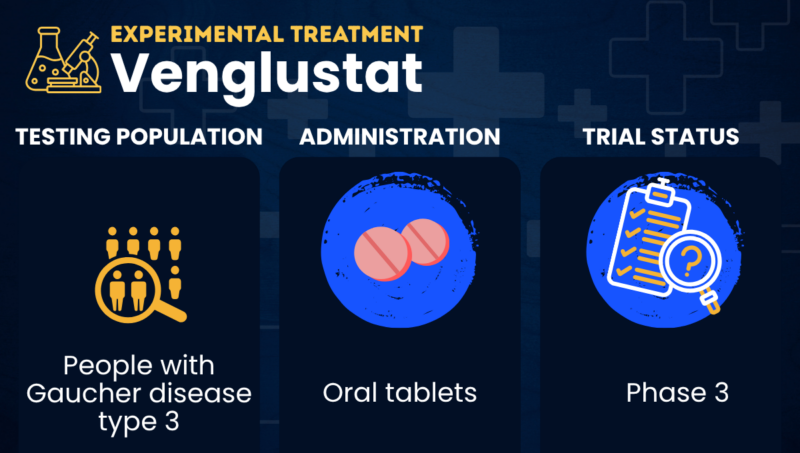
Venglustat is an oral substrate reduction therapy, or SRT, being developed by Sanofi for treating Gaucher disease type 3, also known as chronic neuronopathic Gaucher disease.
Gaucher disease is caused by mutations in a gene that encodes an enzyme needed to break down certain fatty molecules. People with Gaucher lack enough functional enzyme, causing these fatty molecules to build to toxic levels in cells, ultimately driving disease symptoms.
As an SRT, venglustat is designed to block the production of these fatty molecules, thereby limiting their toxic accumulation to slow disease progression.
Gaucher type 3 is marked by symptoms throughout the body as well as neurological symptoms. Enzyme replacement therapy (ERT), a standard Gaucher treatment that delivers a working version of the defective enzyme, can help manage some type 3 symptoms – but ERT products cannot cross into the brain, so they do not ease neurological symptoms. Venglustat is notably able to access the brain, so it is expected to help manage neurological complications.
Based on positive data from a Phase 3 trial, Sanofi is planning to seek regulatory approval of venglustat for Gaucher type 3 in 2026. The treatment holds breakthrough therapy status in the U.S., as well as fast track and orphan drug designations. All are intended to expedite a therapy’s development and review. Sanofi is also developing venglustat for the treatment of Fabry disease.
| Treatment name | Venglustat |
| Administration | Oral tablets |
| Clinical testing | In Phase 3 testing for Gaucher disease type 3 |
How will venglustat be given in Gaucher disease?
In an ongoing Phase 3 study, venglustat is being administered as daily oral tablets, although the dose has not been published. In a previous Phase 2 clinical trial, venglustat was taken at a daily dose of 15 mg.
Venglustat in Gaucher clinical trials
Venglustat is now being tested in a Phase 3 clinical trial called LEAP2MONO (NCT05222906), which enrolled 43 people with Gaucher type 3. Participants are ages 12 and older and had been on ERT for at least three years. All were randomly assigned to receive either Sanofi’s approved ERT therapy Cerezyme (imiglucerase) or venglustat for about a year. Interim trial results showed that:
- participants on venglustat experienced significant improvements on two measures of neurological function compared with participants on Cerezyme, one an assessment of cognition and one of ataxia, a motor coordination problem
- venglustat was as good as Cerezyme for controlling certain nonneurological symptoms, performing similarly to the ERT in reducing spleen and liver size, and boosting levels of hemoglobin, the protein that helps red blood cells carry oxygen
An earlier Phase 2 study called LEAP (NCT02843035) tested daily venglustat (15 mg), given in addition to Cerezyme, in 11 adults with Gaucher type 3. Those results showed that, after about a year of treatment:
- levels of fatty molecules that accumulate in Gaucher were decreased in the blood and fluid surrounding the brain, or the cerebrospinal fluid (CSF)
- patients who experienced CSF reductions in these molecules tended to also have an increase in total brain volume and signs of healthier brain connections
- ataxia was slightly eased for nine of the participants, but cognition generally deteriorated over time
Venglustat side effects
In a Phase 3 trial, common side effects that were more frequently reported with venglustat than with Cerezyme were:
- nausea
- spleen enlargement
- diarrhea
In a Phase 2 trial, the most commonly reported safety events in people who received venglustat with Cerezyme were:
- headache
- back pain
- upper respiratory tract infection
- diarrhea
- vomiting
- acne
Most of these were mild or moderate and were not considered treatment-related.
Gaucher Disease News is strictly a news and information website about the disease. It does not provide medical advice, diagnosis, or treatment. This content is not intended to be a substitute for professional medical advice, diagnosis, or treatment. Always seek the advice of your physician or other qualified health provider with any questions you may have regarding a medical condition. Never disregard professional medical advice or delay in seeking it because of something you have read on this website.